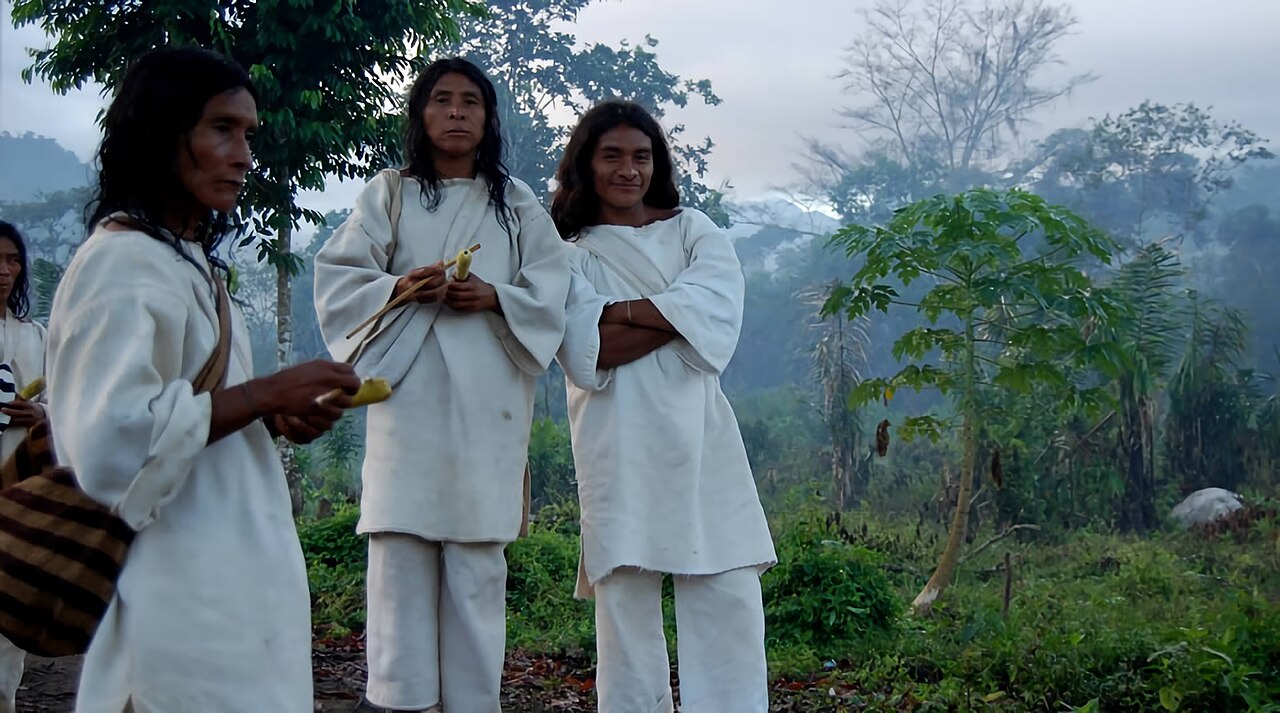
The Kogi people, or Kágaba in their language meaning 'jaguar', are one of Colombia's indigenous groups inhabiting the Sierra Nevada de Santa Marta mountain region. With a population of approximately 15,820 people based on the 2018 census, they are the inheritors of the Tairona civilization's traditions, which existed before the arrival of Spanish colonizers. Their culture has continued to evolve since the Pre-Columbian era, despite criticisms that view them as 'noble eco-savages' without considering the history of interactions and tensions in the region.
Language and Identity
The Kogi language belongs to the Chibchan language family and is closely related to the languages of other tribes in the Sierra Nevada, such as Arhuaco and Ika. It is primarily an oral language, though efforts have been made to develop a writing system for educational and cultural preservation purposes. This language is a crucial element of Kogi identity, used in daily communication, ritual ceremonies, and the transmission of traditional ecological knowledge, including agricultural practices and spiritual beliefs.
History and Origins
The Kogi people are descendants of the advanced Tairona civilization, known for constructing stone structures and forest paths, as well as producing gold artifacts. Before the arrival of Spanish conquerors, the Tairona were forced to relocate to higher ground due to attacks by the Carib tribes around 1000 AD. This new area proved strategic when the Spanish arrived in the 15th century. Missionaries later influenced their way of life by building chapels and churches to convert the local population. However, life in the mountains allowed them to avoid the worst effects of colonization and maintain their traditional way of life.
Spiritual Beliefs
The Kogi base their lives on the belief in 'Aluna', the thought of the 'Great Mother', considered the creator. The Great Mother is called 'Gaulčováng' and is believed to have created the universe from a primal ocean based on images that already existed in her mind. An incestuous relationship between the Great Mother and her son Sintána gave birth to humans. The Earth is considered a living being, and humans are its 'children'. The exploitation and destruction of natural resources by modern humans are seen as weakening the Great Mother and leading to destruction.
Their sacred mountain, Gonawindua (Pico Cristóbal Colón), is considered the 'Heart of the World'. The Kogi call themselves 'Elder Brothers' who protect this world, while outside civilizations are 'Younger Brothers' sent away from the Heart of the World. From birth, members of the Kogi society are trained to be mamos (spiritual leaders) responsible for guidance, healing, and leadership. Mamos undergo rigorous training from childhood, usually before the age of 5, in remote and high-altitude locations. They are taught to overcome worldly desires through abstinence from sex, food, sleep, and nightlife. Through deep concentration, symbolic offerings, and divination, mamos believe they support the world's balance and creativity.
Cosmology and Socio-Religious Concepts
Traditional Kogi religion is closely linked to a cosmic structure expressed in dualistic terms. The sun divides the universe into two hemispheres: east/west and consequently right/left. This dualistic concept is used to explain worldly divisions such as male/female, hot/cold, light/dark. Each pair is a complementary opposite. In the case of good/evil, the Kogi believe that occasional sin justifies the existence of good. The four cardinal directions (north/south/east/west) are associated with concepts of good/evil, influencing the arrangement of villages, clans, and the division of the Sierra Nevada. In ceremonial houses, a line drawn across the center of a circle divides men into the left side (the 'more knowing') and the right (the 'less knowing'). The center of the circle is a crucial point where the mamo places four sacred offerings and 'speaks with the gods'. Kogi cosmology adds three dimensions: Zenith, Nadir, and Center, forming nine layers of development like a cosmic egg representing the womb of the Great Mother.
Funeral Customs
Death is not considered a tragedy but a 'fulfillment of life'. The burial process takes about two hours without prayers or singing. This ceremony is an act of 'cosmicization' where the mamo returns the deceased to the womb of the Great Mother. Components of the ceremony include placing the body in a fetal position within a net, with ropes tied to the hair symbolizing the placenta and umbilical cord. The body is placed on the left side with the head facing east. Offerings are placed at the sides, center, and top of the grave, related to sacred points. After nine days, the spirit is believed to be reborn into another world.
Lifestyle and Traditions
Kogi men receive a poporo upon reaching adulthood. A poporo is a small gourd filled with lime powder used with chewed coca leaves. This tradition connects them with nature. White clothing symbolizes the Great Mother and the purity of nature. They live in circular villages called Kuibolos, with round huts made of stone, mud, and palm leaves. Men live separately from women and children. Each village has a large hut (nuhue) entered only by men for discussions and decisions. Women are believed to be closer to the Great Mother and do not need to enter temples. Marriages are often arranged by the mamos to ensure a fertile community, but there is no coercion.
Contemporary Kogi
The Kogi practice slash-and-burn agriculture, with each family cultivating plots at various altitudes in the Sierra to meet their needs. They also raise cattle in the highlands. In 2012, the Kogi collaborated with filmmaker Alan Ereira to produce the documentary 'Aluna', a continuation of the 1990 BBC documentary 'From the Heart of the World: Elder Brother's Warning'. In the film, they voiced their concerns to modern humanity (the Younger Brothers) about rapid ecological changes and the pollution of sacred sites as causes of climate change and world destruction. Although their initial warnings were not heeded, the Kogi continue to play their role as 'Elder Brothers' protecting the balance of nature.
Understanding the Kogi People: Guardians of Nature from the Sierra Nevada de Santa Marta. The Kogi people, also known as Kágaba, are an indigenous group from Colombia residing in the Sierra Nevada de Santa Marta mountains. Believed to be the heirs of the Tairona civilization, they are renowned for their deep spiritual beliefs and practices of maintaining ecological balance.. The Kogi people, or Kágaba in their language meaning 'jaguar', are one of Colombia's indigenous groups inhabiting the Sierra Nevada de Santa Marta mountain region. With a population of approximately 15,820 people based on the 2018 census, they are the inheritors of the Tairona civilization's traditions, which existed before the arrival of Spanish colonizers. Their culture has continued to evolve since the Pre-Columbian era, despite criticisms that view them as 'noble eco-savages' without considering the history of interactions and tensions in the region.
Language and Identity
The Kogi language belongs to the Chibchan language family and is closely related to the languages of other tribes in the Sierra Nevada, such as Arhuaco and Ika. It is primarily an oral language, though efforts have been made to develop a writing system for educational and cultural preservation purposes. This language is a crucial element of Kogi identity, used in daily communication, ritual ceremonies, and the transmission of traditional ecological knowledge, including agricultural practices and spiritual beliefs.
History and Origins
The Kogi people are descendants of the advanced Tairona civilization, known for constructing stone structures and forest paths, as well as producing gold artifacts. Before the arrival of Spanish conquerors, the Tairona were forced to relocate to higher ground due to attacks by the Carib tribes around 1000 AD. This new area proved strategic when the Spanish arrived in the 15th century. Missionaries later influenced their way of life by building chapels and churches to convert the local population. However, life in the mountains allowed them to avoid the worst effects of colonization and maintain their traditional way of life.
Spiritual Beliefs
The Kogi base their lives on the belief in 'Aluna', the thought of the 'Great Mother', considered the creator. The Great Mother is called 'Gaulčováng' and is believed to have created the universe from a primal ocean based on images that already existed in her mind. An incestuous relationship between the Great Mother and her son Sintána gave birth to humans. The Earth is considered a living being, and humans are its 'children'. The exploitation and destruction of natural resources by modern humans are seen as weakening the Great Mother and leading to destruction.
Their sacred mountain, Gonawindua Pico Cristóbal Colón , is considered the 'Heart of the World'. The Kogi call themselves 'Elder Brothers' who protect this world, while outside civilizations are 'Younger Brothers' sent away from the Heart of the World. From birth, members of the Kogi society are trained to be mamos spiritual leaders responsible for guidance, healing, and leadership. Mamos undergo rigorous training from childhood, usually before the age of 5, in remote and high-altitude locations. They are taught to overcome worldly desires through abstinence from sex, food, sleep, and nightlife. Through deep concentration, symbolic offerings, and divination, mamos believe they support the world's balance and creativity.
Cosmology and Socio-Religious Concepts
Traditional Kogi religion is closely linked to a cosmic structure expressed in dualistic terms. The sun divides the universe into two hemispheres: east/west and consequently right/left. This dualistic concept is used to explain worldly divisions such as male/female, hot/cold, light/dark. Each pair is a complementary opposite. In the case of good/evil, the Kogi believe that occasional sin justifies the existence of good. The four cardinal directions north/south/east/west are associated with concepts of good/evil, influencing the arrangement of villages, clans, and the division of the Sierra Nevada. In ceremonial houses, a line drawn across the center of a circle divides men into the left side the 'more knowing' and the right the 'less knowing' . The center of the circle is a crucial point where the mamo places four sacred offerings and 'speaks with the gods'. Kogi cosmology adds three dimensions: Zenith, Nadir, and Center, forming nine layers of development like a cosmic egg representing the womb of the Great Mother.
Funeral Customs
Death is not considered a tragedy but a 'fulfillment of life'. The burial process takes about two hours without prayers or singing. This ceremony is an act of 'cosmicization' where the mamo returns the deceased to the womb of the Great Mother. Components of the ceremony include placing the body in a fetal position within a net, with ropes tied to the hair symbolizing the placenta and umbilical cord. The body is placed on the left side with the head facing east. Offerings are placed at the sides, center, and top of the grave, related to sacred points. After nine days, the spirit is believed to be reborn into another world.
Lifestyle and Traditions
Kogi men receive a poporo upon reaching adulthood. A poporo is a small gourd filled with lime powder used with chewed coca leaves. This tradition connects them with nature. White clothing symbolizes the Great Mother and the purity of nature. They live in circular villages called Kuibolos, with round huts made of stone, mud, and palm leaves. Men live separately from women and children. Each village has a large hut nuhue entered only by men for discussions and decisions. Women are believed to be closer to the Great Mother and do not need to enter temples. Marriages are often arranged by the mamos to ensure a fertile community, but there is no coercion.
Contemporary Kogi
The Kogi practice slash-and-burn agriculture, with each family cultivating plots at various altitudes in the Sierra to meet their needs. They also raise cattle in the highlands. In 2012, the Kogi collaborated with filmmaker Alan Ereira to produce the documentary 'Aluna', a continuation of the 1990 BBC documentary 'From the Heart of the World: Elder Brother's Warning'. In the film, they voiced their concerns to modern humanity the Younger Brothers about rapid ecological changes and the pollution of sacred sites as causes of climate change and world destruction. Although their initial warnings were not heeded, the Kogi continue to play their role as 'Elder Brothers' protecting the balance of nature.