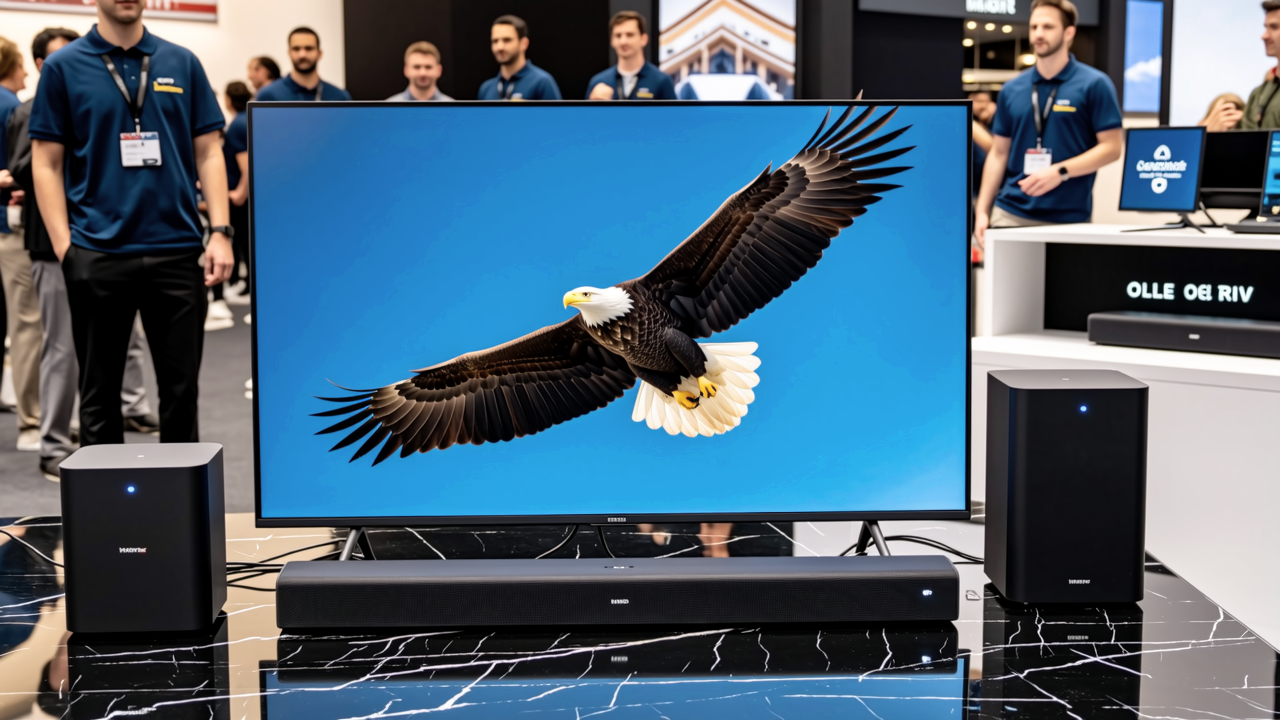
At the CES 2025 exhibition hall, an 115-inch TCL screen monopolized attention. It was not just a TV; it was a wall-sized image. Visitors stood mesmerized, turning their heads left and right to catch the corners of the image. "This size is crazy," said Ahmad, a software engineer from Kuala Lumpur who came to Las Vegas to see it for himself. "But after ten minutes, my eyes started to feel tired. It's like sitting in the front row of a movie theater."
The Never-Ending Size Race
The television market over the past decade has shown a clear trend: the bigger, the better. If a 50-inch TV was considered huge in 2010, now 75-inch is the standard for luxury living rooms. Samsung, LG, Sony, and Chinese brands such as TCL and Hisense are racing to release 85-inch, 98-inch, and even 110-inch models for consumers. Their prices are also becoming more affordable: an 85-inch TV can now be found under RM10,000, compared to RM50,000 five years ago.
According to data from research firm Omdia, sales of TVs 75 inches and larger increased by 42% in 2024 compared to the previous year. "Consumers want a cinematic experience at home," said Dr. Lim Wei Ming, an electronics market analyst. "As large panels become cheaper, more people are willing to buy them."
Technology Behind the Giant Screens
However, making a big TV is not just about installing a wider panel. The technology behind it is as complex as producing silicon wafers. LCD and OLED panels require high molecular precision. For sizes exceeding 85 inches, the defect rate increases exponentially. Samsung uses micro-LED technology that arranges millions of tiny diodes. TCL, on the other hand, optimizes the LCD manufacturing process with Mini-LED backlights to control local brightness.
"The biggest challenge is brightness and color uniformity," explained a TCL spokesperson during a press conference. "When the screen is too large, temperature differences between the edges and center cause color variations. We overcome this with real-time calibration algorithms."
In another corner, LG showcased a 97-inch OLED TV that is only 2.5 centimeters thick. OLED technology allows perfect black colors, but its weakness is the risk of burn-in and shorter lifespan compared to LCD. Nevertheless, for movie enthusiasts, the image quality of OLED is hard to resist.
Physical and Biological Limits
But can TV sizes keep growing without limits? The answer depends on three factors: physical space, resolution, and human physiology.
First, room size. TVs need to be placed at an appropriate viewing distance. According to the Society of Motion Picture and Television Engineers (SMPTE), the ideal viewing angle is between 30 to 40 degrees. For a 100-inch TV, the minimum distance is approximately 3.5 meters. Most urban homes do not have such large living spaces.
Second, resolution. The larger the screen, the more visible the pixels if the resolution is not increased. A 4K (3840x2160) TV on an 85-inch screen already starts showing fine details at close distances. To exceed 100 inches, one must switch to 8K (7680x4320). "8K is still not mainstream due to content shortages," said Dr. Lim. "An 8K TV at home is only useful if you sit very close."
Third, human field of view. Our eyes can only focus on a specific area. When the screen is too large, we need to move our heads to see the edges. This causes eye strain. A Stanford University study found that screens exceeding a 70-degree viewing angle increase eye strain by 30%.
What Do Experts Say?
We met Prof. Dr. Sarah Chin, an optometry expert from the University of Malaya, outside the exhibition hall. "Biologically, the human eye is not designed for screens that fill the entire visual field," she said. "Imagine sitting in the front row of a cinema. You cannot enjoy the movie because you have to turn your head. It's the same with giant TVs. They may be impressive, but they are uncomfortable for long viewing sessions."
She advised users to measure the space before buying. "Use a simple formula: multiply the diagonal size of the TV in inches by 1.5 to get the minimum viewing distance in inches. For example, a 100-inch TV requires a distance of 12.5 feet (3.8 meters). If your space is not enough, don't buy it."
Meanwhile, TV manufacturers are looking for ways to overcome these limits. Samsung introduced 'The Wall' - a modular micro-LED wall that can be installed in any size and shape. "At the exhibition, they showed a 292-inch wall for commercial spaces," reported Ahmad. "It weighs hundreds of kilograms and requires professional installation. For homes, it's still not practical."
Conclusion: Is Size Really Important?
The trend of increasing TV sizes will certainly continue, but at some point, it will reach a peak. In the residential market, sizes between 100 to 110 inches may be the acceptable limit. For larger spaces, laser projectors and video walls may take over. For most users, a 75-inch TV is sufficient for a regular room. The most important thing, said Dr. Lim, "image quality, contrast, and refresh rate. Size is just one factor."
Before leaving the exhibition, I stopped by the Sony booth. A salesperson showed an 85-inch TV with a demo content: a field of lavender flowers. Visitors praised its colors. No one asked, "Is there a bigger size?" Perhaps, for now, it's enough.